I Remember Hubert Sumlin

Hubert Sumlin died last month. He was Howlin' Wolf's guitarist from the time Wolf came to Chicago around 1954 to his last performances in the mid '70s. Those twenty years on the road, in the clubs and on record are unrivaled - this was the deepest, hardest blues.

They were one of the greatest pairings in music - the great seer and his loyal protoge. I can't think of too many parallels - John Gilmore and Sun Ra, or Ellington and Johnny Hodges, except they had many great soloists in their groups. Monk and Charlie Rouse, but Rouse was with Monk for less than ten years, and it wasn't Monk's greatest period. Sonny Rollins and Bob Cranshaw, but Cranshaw isn't a soloist.

He was, to my mind, the happiest of blues guitarists. The feeling that emanates from his playing is different from the tortured, dark night of the soul blues of Otis Rush, or the searing passion of Buddy Guy and Magic Sam. Sumlin is giddy, bubbling over with enthusiasm. Great as they are, Guy and Rush were very much coming out of B.B. King's. Sumlin's sound is instantly recognizable, and totally original. His strings sound like skinny electrical wires that might overload with current at any moment. He like the "out-of phase" sounds of two single coil pickups, and he often played cheap Italian-made electric guitars. He wasn't from the "milk a few notes" school of Albert King. He played with his fingers, like a lot of bluesmen, but his attack and vibrato were very pronounced and distinctive. 

Perhaps his finest moments were in the series of (mostly Willie Dixon-penned) hits Wolf had in the early 60's: 300 Pounds of Joy, Built For Comfort, Hidden Charms, I Walked All The Way From Dallas. This is Wolf at his most entertaining, even charming - a world away from the dark undertones 50's era songs Smokestack Lightning, or You Gonna Wreck My Life. Sumlin's playing on these sides is magic. When Wolf sings "I'm so glad, you understand, I'm 300 pounds of muscle and man" on 300 Pounds Of Joy, Sumlin's repeated chord stabs are so funky, so galvanizing, just thinking about them now gives me goose bumps. His solo on on the uptempo Hidden Charms is delirious, joyful and so damn fun.

*******

Like so many white kids past and present, the love I had at 13 for Led Zeppelin, the Allman Brothers, and the Rolling Stones turned into ravenous desire by age 16 for all things Robert Johnson, Son House, Muddy Waters, Howlin' Wolf, and B. B. King.

As with all my other musical obsessions throughout the years, I found a mentor. This has always been my modus operandi from day one, regardless of musical genre. My blues mentor was Twist Turner and he was one of the greatest people - and biggest characters -  I have ever met. 

I met him at Seattle's Bumpershoot Festival in the early 80's. We were in the large auditorium to hear Koko Taylor, followed by Buddy Guy and Junior Wells. (Except no Junior Wells, which went unremarked until someone in the audience shouted “Where's Junior?” “He missed the flight,” deadpanned Buddy Guy.) Twist was directly behind my friend Fletcher and me, sitting with Blackie Jo James, a local blues singer I had seen. I think I turned around to ask her a question about Koko Taylor's guitarist – to me Blackie Jo James was a real blues celebrity. She replied “You should ask this guy,” indicating Twist, “he played with him for years.”

Twist Turner had a diamond in his front tooth, a full length fur coat, and carried a pistol. I am not making this up. He was a drummer who had grown up in Seattle and moved to Chicago the day after he graduated from High School, to play the blues. That was maybe fifteen years ago, and he was temporarily back in Seattle, living in his dad's basement, trying to figure out what came next. He had released a couple of 45's of his own songs, on his own label, in Chicago, which had gone nowhere. He had played a million gigs around Chicago, and on the road around the Midwest for $50 a night. He was white, but if you talked to him on the phone, you would have swore he was black. This could sometimes be awkward, when he showed up for a gig he had been hired for by someone he'd never met.


I spent a lot of time with Twist in his dad's basement, listening to records, playing the blues, and hearing incredible stories of life in the blues trenches (the time a blues singer pulled a pistol and shot a rat in his apartment, the time someone's girlfriend was hailing a cab completely naked, the bass player who could only play a medium shuffle...). He was extraordinarily kind to me. I went to most of his local gigs, standing out in front of the clubs because I was too young to get in, often in rather skanky neighborhoods. Once I sat in with his group, playing electric guitar out in front of the Pioneer Square club with a cable running from the sidewalk through the window to the stage. Once I was listening to Twist from the entrance to a bar and I was mistaken for a doorman by some tourists who inquired after the cover charge. I collected six dollars from them. 

During the couple of years that he was back in Seattle (this is around 1982-83) Twist sometimes set up gigs for former employers and colleagues he had worked with in Chicago. I saw pianist Sunnyland Slim in this way, and I met and played a little with Hubert Sumlin. I spent the afternoon with Sumlin at Twist's dad's house. I don't remember why I wasn't able to go to the gig they played that evening; perhaps it was out of town, or maybe I had a family commitment.

He had probably had a couple drinks by the time I got there, in the early afternoon. He was very silly, very animated, and with a child's utter spontaneity. We played together, on unamplified electric guitars, sitting on the shag carpet in the basement, almost knee to knee. We played for perhaps ten minutes, trading blues chorues. “Play what you feel, man!” he exhorted me. With a teenager's chutzpah, what I “felt” was a Thelonious Monk-inspired emphasis on dissonance, minor seconds and tritones. He was unfazed by this, took it in stride. I was very familiar with his playing by the age of 16, had learned all of his parts on the classic Wolf records: Killing Floor, Forty-Four, Evil, How Many More Years. In my mind there was a link between Sumlin's gloriously personal eccentric thumb and finger style and the piano playing of Skip James, Monk and even Cecil Taylor, who I had just discovered. I thought I would make the point evident to him - which of course makes me roll my eyes now. 

Etched in my mind forever is the backward somersault he did, while playing, on that shag carpet. It came out of nowhere, and it was beautiful. He was exageratedly expressing enthusiasm for something I played, goofily pretending to be bowled over. I think my mouth was hanging open when he came up still playing and laughing. He laughed a lot.

I remember he talked about hearing Howlin' Wolf as a teenager outside of a juke joint, standing on some crates to look into a window, because he was too young to get in. The story made an impression on me because I was already familiar with it from reading interviews with Sumlin.  Here I was with one of musical idols, and I was thinking "Yes, yes, I know, I've heard this story before!" like he was my uncle or something. I remember too he managed to speak several times of his great fondness for sexual intercourse, although not in those terms. 

So, that's my Hubert Sumlin story. The meeting I had with him lasted maybe a couple of hours. But the hours I've spent listening to him on record and watching video tapes of him and Wolf could fill weeks.  He gave me a lot of joy.

Posted in Music Thoughts | Comments Off

Thank You Paul Motian.

       My wife is a Scrabble fanatic. She's very, very good. I tried, when we first started going out, playing with her a couple times. She whupped me so bad, I quit. In one of our only games, I did something she teased me about for many years: I put down the letters "m-o-t-i-a-n". "What's that," she said? "Motion", I replied. "That's not how it's spelled!" she said, laughing in bewilderment at the obviously verbally challenged man-child opposite her. "Oh," I said, feeling suddenly somewhat alone. "Well, to me it is."

     His name was beautiful, his sound was beautiful, his time was beautiful, and his songs were beautiful.

     Were, are, is.

     When Paul Motian spoke of Chick Webb, or Gene Krupa or, as in a short but memorable video youtu.be/dPfTjgc0wN4 Jimmy Crawford, he spoke of them as life changers, personal heroes, gods. Of course, that's what Motian was to so many. For me he embodied everything I love about Jazz. For me he was someone who made getting older look like a real privilege. Someone who made improvising look easy, and yet masterful and elusive, somehow simultaneously. 

     Beauty, beauty, beauty. Swing, swing, swing.

     Smile, surprise, sound, song. 

     Thank you Paul Motian. I'm sorry you didn't get ten more years. Being on the road for sixty years takes its toll. But you gave and gave and gave, and your music is one of our communities' most treasured possessions. 


Posted in Music Thoughts | Comments Off

Speaking of Trios:

     I had never seen footage of Paul Motion playing with Bill Evans before (which doesn’t mean there isn’t any, I’m far from systematic about watching jazz videos). But it’s wonderful to see him, here with Chuck Israels in April of 1962. Perhaps this is the earliest substantial footage of Evans? The sound and picture quality isn’t great, but it’s 26 minutes of “averagely great”playing, if you will. It’s just cool to see Motion at this point, on brushes throughout, and to be grateful that he’s still making such vital music almost fifty years later. They play Nardis, Blue In Green, In Your Own Sweet Way (Israels and Motion working it here), Time Remembered, Re: Person I Knew, Waltz for Debby (oh man, Motion is swinging!), and a teensy bit of Five.

Posted in Music Thoughts, Recordings, new and used | Comments Off

Trio, Trios, Triest(e)

     I'm deep in Trios lately. I've waited a long time to perform or record standards in a guitar-bass-drums trio setting, because those songs mean so much to me and are too often taken for granted, and because the trio legacy is so deep and imposing. But Now Is The Time. I'm enjoying playing with several configurations of bassists and drummers, each wonderful and different.

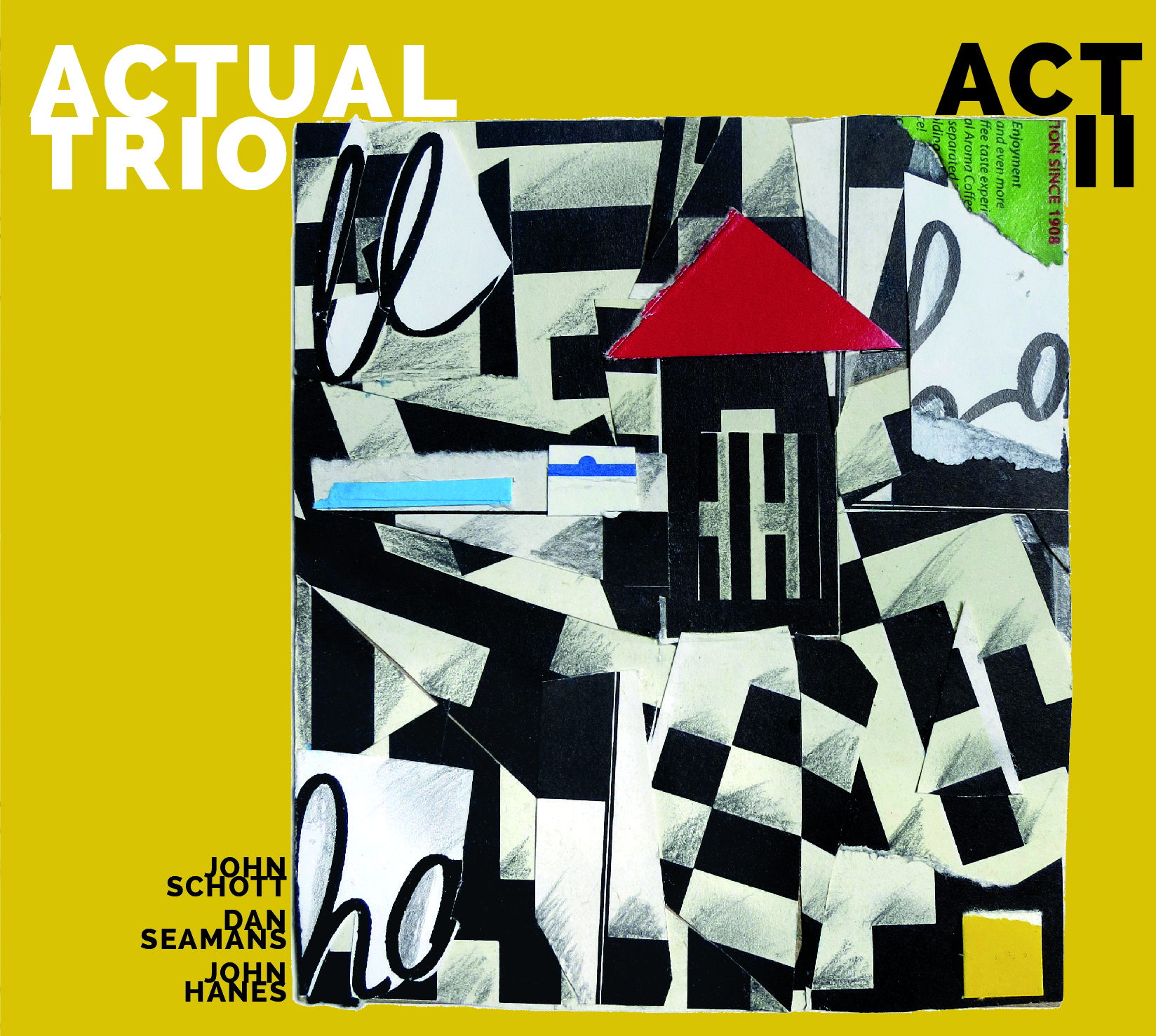
Dan Seamans and Tom Hassett

     ► Played at the Ivy Room in Albany last March.

Dan Seamans and John Hanes

     ► Played Nov. 7 at Cafe Royale in S.F.

John Wiitala and John Hanes (three Johns, no waiting!)

     ► Playing at Cafe Giovanni in Berkeley on Dec. 13.

John Wiitala and Jordan Glenn

     ► Playing at the Actual Cafe in Berkeley January 15.

John Wiitala and Smith Dobson V

     ► Recorded at Guerrilla in Oakland in October. 

I've uploaded a recording of John Wiitala, Jordan Glenn and me playing Body and Soul, recorded by Myles Boisen last April. You can hear it in the Jukebox at right.

Posted in Live Music, Music Thoughts, Recordings, new and used | Comments Off

Tom Waits’ new album Bad As Me

I'm the fuzzy pink dot next to the "W". 

     Tom Waits' new CD was released today. I play on two songs on disc two of the "Deluxe Edition": She Stole The Blush and Tell Me. Much will be made of the famous names that show up in the credits: Keith Richards, David Hidalgo, Flea, Marc Ribot, and Les Claypool (none of whom I met). But what is nice for me is seeing some of my friends listed there too, most of whom I had no idea were part of the recording: Will Bernard, Chris Grady, Marcus Shelby, and Gino Robair. 

Posted in Recordings, new and used | Comments Off

pierre boulez, pli selon pli, and me (part one)

The link below is to a video of pli selon pli: Pierre Boulez conducting the EIC and Lucerne Festival Academy with Barbara Hannigan, soprano on September 27, 2011 at the Salle Pleyel. The performance will be available on the web through Dec. 27, 2011.

 www.citedelamusiquelive.tv/concert/0974485.html#

     Incredible: to see and hear this concert in a beautifully filmed performance, two days after it was give on the other side of the planet. When I think of how hard it used to be, tracking down obscure recordings of Boulez's music, some released only in Europe! Taping things off the radio, trying to, sort of, "translate" French interviews with Boulez I'd find in the music library at the University of Washington. Laboriously xeroxing scores from that same library, which were checked out on some older friend's card. For twenty-five years I've been obsessed with Boulez - obsessed! Not uncritically mind you - at times the obsession was ruthlessly critical, ferocious. But he was always, always on my mind, as I swung back and forth between infatuation and disappointment, imitation and exasperation. 

     And now here it is, 2011, and the fight is over for Boulez and I. He is 86, and has now performed and recorded his works countless times. Pli Selon Pli will no longer be withdrawn and revised, as it was countless times between the early sixties and the late eighties. The performance linked to above is thought to be the last time he will conduct this piece. I no longer have to try to imagine what obscure pieces like, say, Cummings ist der Dichter or the withdrawn Poésie pour Pouvoir sound like - numerous recordings and even pdf scores are passed around the web like so many funny cat videos.

     The first recording I heard of Pli Selon Pli was the Columbia LP, checked out of the Seattle Public Library when I was probably still in high school. Whatever was the most intense, most complex music, that's what I wanted to hear. I now see this predilection on my part was a direct continuation of the intensity and passion that bands like The Who, the Clash, AC/DC, and Led Zeppelin had bred in me. I taped that recording of PSP onto cassette, and lived with it for several years.

     I also came to know Notes of an Apprenticeship, the mid-60s collection of Boulez's essays (translated into English), also from the library. That too made a huge impression on me. Boulez, far from being the paragon of complexity he was usually made out to be, presented an aesthetic world that was refreshingly simple: "anyone who hasn't experienced the necessity of the serial language is useless." 

     Boulez was so punk, so brutal, so rigorous, so exacting. I loved the attitude, and that led me into the music. By this time there were plenty of people - particularly on the West Coast? -  who talked about how oppressive and exclusive they found this music, how offensive. Gerard Schwarz, the conductor of the Seattle Symphony, championed neo-Romantics like Andrej Panufnik and Stephen Albert. Some teachers at Cornish, where I studied music, were in the throes of rebellion from the academic music departments they had come up in. I thought these people were wimps

     One of the wonderful things about Cornish College was its legacy of percussion music - it was there that John Cage "invented" the prepared piano, because he couldn't fit a percussion ensemble into the pit of the auditorium for a dance performance. The supernaturally gifted percussionist Matthew Kocmieroski led the percussion ensemble at Cornish in the years I was there, and non-percussionists like myself could join. Amazing as it seems to me now, we actually performed the second movement of PSP, Improvisation sur Mallarme No. 1, in its original version for soprano, piano, and eight percussionists. I played a part for three cymbals, I'm sure among the worst interpreters of this part the piece has ever received.

     Student ensembles non-withstanding, I was keenly aware that in Seattle I had no little to no opportunity to experience the avant-garde music I was obsessed with first hand. In 1986 I actually bought a plane ticket to San Francisco to see Boulez and the Ensemble Intercontemporain give a performance of Repons and Dialogue de l'ombre double at the Civic Auditorium. My composition teacher in college, Bun-Ching Lam, who had some affinity for the European avant-garde, had many Bay Area friends and put me in touch with someone on whose couch I could crash.

     Even though the performance was in the evening, I was at the Civic Auditorium in the early afternoon, sniffing around to see I what I could see. Sure enough, an extensive sound check was under way, and it was a simple matter to walk in and sit down. Boulez, Andrew Gerzo, and clarinetist Alain Damians were working on the clarinet and electronics piece Dialogue, and several EIC members were milling about. I struck up a conversation with the friendly French hornist Jens McNamara, who I was surprised to discover was an American. 

     And then the sound check was over, and Boulez was done, and standing near me. 

     "Maestro Boulez, I have travelled 2,000 miles to be hear today." [Actually I had no idea how many miles it was, I just made that number up; it's closer to 800.]

     "Well, I hope you won't be disappointed." 

     I assured him that I could not be disappointed in my hero Pierre Boulez. We exchanged some small talk - I had read somewhere that he had recorded Berio's Sinfonia - would that recording ever be available? Yes, he replied, but he had just recorded another piece of Berio's to fill out the disc. After a few more quite trivial exchanges, I let him go, and watched him walk out of the building and down the block until he was out of site. 

     The concert that evening was fine. Perhaps I was actually was a little disappointed by the constant trills and "frenzy in one place" of Repons, but of course with so much invested in the trip, I could not admit it to myself. But the standout memory of the trip was worth the whole price of admission. During the soundcheck, while Damians played passages from Dialogue into a microphone, and other pre-recorded passages were played back in various speakers around the hall, he played a particular passage that sounded awfully close to: 


first part of the first movement of Beethoven's Ninth Symphony

     Boulez, busy looking over Gerzo's shoulder, chuckled, looked up at Damians across the large auditorium and sang back to him: 


the conclusion of the phrase.

     This moment is so vivid to me -  a kind of reaching across the centuries that represented everything I wanted from this pilgrimage, from Boulez, and from Classical Music Itself. A connection, a lineage, between the past and the present, and the consoling presence of role models both living and long buried.

     Around 1988 I bought my first Compact Disc, Boulez's second recording of PSP, on Erato, at Tower Records in Seattle. I owned that CD, and only that CD, for at least two years before I bought an actual CD player ("these things are for rich snobs, they'll never catch on!"); by that time I had moved to Oakland. In the interim I probably listened to that disc all of three times, mostly at the bookstore where I worked, after closing. (To be continued...)

Posted in Live Music, Music Thoughts, Recordings, new and used | Comments Off

My problem.

 from Janet Malcolm's profile of photographer Thomas Struth in the current New Yorker:

     "Struth's invisible cloth of obliviousness was as necessary to his art-making as the actual cloth he worked under. To enter the state of absorption in which art is made requires reserves of boorishness that not every exquisitely courteous person can summon but that the true artist unhesitatingly draws upon."

Posted in Uncategorized | Comments Off

A serious candidate for the most profound thing anyone ever said to me

      When I was in high school, I had a music buddy whose name I have hopefully temporarily forgotten. We were only friends for about six months, so it's not the worst sin that I can't remember his name, although I am stupefied to discover this memory lapse now. He was a "grown-up", perhaps 28 ( I could be seriously off here, I just am not sure), a guitarist, and had a great Jazz record collection. He was super nice to me, and made no big deal of our age difference. He played in a rockabilly band, and gave me a green coat I wore for years. I'd go over to his house, we'd play guitar together and I would tape his records. In those days I'd do anything to make friends with someone who had a good record collection. I HAD to hear this stuff, and even records we think of totally canonical now, like, say, "Way Out West" or "Bird & Diz" were really hard to find. I still have a bunch of these tapes - Rollins, Monk, Bill Evans - mostly Milestone "two-fers".  At the time my nameless friend (David?) was taking lessons from Gary Peacock in "reharmonization". I think he had taken classes from Peacock at Cornish, and then continued on privately. Reharmonization, I learned, was putting different chords to familiar Jazz standards.

     Around this time my uncle Jack died and left me some money, I think $1,500. I decided that with this money I too would take lessons in reharmonization from Gary Peacock (never mind that I didn't even know the original chords of standards!). I really didn't know much about him, mostly just resume items  - he had played with Bill Evans and Albert Ayler. I doubt I had heard much Bill Evans, except for Kind of Blue and maybe Sunday at the Vanguard; I'm certain I hadn't heard Albert Ayler. Keith Jarrett's "Standards Vol. 1", with Peacock and Jack DeJohnette, came out right about this time, 1983, and I did get that. Miles had recently come out of retirement, and Wynton's second record had just been issued. 

     At the time Peacock lived with his wife and kids in Seattle's University District, about a 15 minute bus ride from my house. After the first or second lesson, I stopped at Peaches, the big record store in Seattle, which was only a couple blocks from his house. There I found the Arista/Freedom reissue of Ayler's Vibrations, with Peacock, Don Cherry, and Sonny Murray. I bought it, and still own this record today. I loved it immediately; it was brash, punky and exuberant. To this kid who had been jamming in basements on Hendrix and Who songs, it sounded familiar and weird at the same time.

     Peacock quickly ascertained that in my case, what was called for pedagogically was some very basic concepts of harmony and melody: the overtone series, scale degrees, how a key is defined, how a melody can express a harmonic progression, etc. I was chastened, which, as I see it now, was probably what I was secretly looking for: a teacher to take me down a few pegs, and build me back up. A teacher who wasn't at all satisfied or impressed with what I thought I knew about music.

     (Did Gary bury his head in his hands after I left, wondering how he had fallen so low as to explain triads to 16 year-olds?)

    I was humbled, starting back at square one, but I still wanted him to know I was hip. I mentioned Ayler and that I had been experimenting with my friends with "free" playing. Did he have any advice? This is my memory of what he said:

    "By 1962, I knew probably 1000 tunes. I could play them in twelve keys, I could play them backwards and forward. They became so ingrained in me that I no longer needed to remember the songs as such, I could just play, and the songs took care of themselves. From there, free playing wasn't so much a leap. I would just play the next note I wanted to play at that given moment. I've come to feel that there is no difference between playing songs and playing free - you're always free to play what you want, what you hear. Even if you're playing a piece of classical music, completely notated, you're still making a choice to play that next note written in front of you, or not. In this sense, all music is free music."

     Dig.

Posted in Music Thoughts | Comments Off

Sarah Wilson at Monterey podcast

www.npr.org/blogs/ablogsupreme/2011/09/21/140610964/monterey-jazz-2011-sarah-wilson-quintet

   At the above link you can listen to the second set from the Monterey Jazz Festival.

Sarah Wilson - trumptet and voice; Charles Burnham - amplified violin; John Schott - guitar; Jerome Harris - acoustic bass guitar; Matt Wilson - drums.

Posted in Live Music | Comments Off

Work!

     ...in the best sense of the word. Thursday, Friday and Saturday I played with a group Sarah Wilson put together, culminating in two sets at the Monterey Jazz Festival, taped for broadcast by NPR. I had been really, really keyed up to meet and play with three musicians I've long admired: Jerome Harris, who I saw with Sonny Rollins when I was about 19; Charles Burnham, a violinist long associated with one of heroes James "Blood" Ulmer, and Matt Wilson, a great drummer, bandleader and composer, who I first heard maybe sixteen years ago with my high school chum Andrew D'Angelo. Opportunities to play with people like this just don't come all that often for me, and I was excited to do this. Moreover, opportunities to play original compositions with the same people for three consecutive gigs don't come often either, and so I was really feeling fortunate. 

     But make no mistake, it was work. Thursday the guys flew in from New York, and we got right down to business with an intense three-plus hour rehearsal at Sarah's place. Some twenty original pieces were very quickly gone through, forms discussed, strategies sketched. Then I loaded the drums and amps in my car and drove to Mill Valley for our show at the beautiful Throckmorton Theater, while Sarah piloted a borrowed van with Charlie, Jerome, and Matt. The gig was really good, though it certainly didn't suffer from being over-rehearsed! The first tune of the evening had a guitar solo with bass and drums over a fast tempo before Sarah or Charlie played a note. At the outset, I felt my left hand sort of lock up - not completely unable to play, but just too tense to get much music out. I was nervous, tense, in a way I hadn't been for quite a while. I had an opportunity to burn, and I definitely wanted to make an impression on all these (in my mind) "big-shot-cats-from-New-York", but you don't burn by saying you're going to burn. You burn by being relaxed, loose and in the moment. After a few stumbling phrases I managed a reasonably okay solo, and proceeded to settle in from there. Sarah's songs, which are very catchy and compelling, and the thrilling playing of the band pushed me into less me-focused territory. 

     The next evening we played for a packed house at the Red Poppy Art House in S.F., which means about forty people. I was nervous about playing with an exuberant quintet in a space the size of my living room, but it worked out fine. I love the Red Poppy vibe, and I always feel that the in-your-face intimacy of the place pulls something special out of me. The music started to open up, spontaneous moments of listening magic were given room to grow, and it started to feel like a band. 

     Home at 11:00 pm, unload all the drums and amps, and up the next morning for the two hour drive to Monterey. A beautiful day, with ample snacks in the car and Blood Ulmer's Sun Sessions blues disc from 2001. (Townes Van Zandt: "There are basically two kinds of songs: blues and zippity doo-dah.") We played two sets in a medium-sized nightclub-like room, to a large, rapt audience. Fun was had. Mistakes were made. Sarah's singing was really inspired. The bright stage lights had us sweating profusely up there, which is secretly my favorite side-effect of gigs like this, even though I'm rank afterwards. I had another moment where I realized I was playing with tension, trying to get up in the groove of a fast tempo guitar solo. To be aware of it in the moment was a better result than the previous Thursday. 

     What was so moving to me was how supernaturally nice these three gentlemen were, and how respectful and attentive they were to Sarah's compositions, while at the same time not holding back anything of themselves as creative musicians. This is also a testament to Sarah's band leading: letting people be themselves, letting musicians play what they hear. I've been singing her songs in my head continuously since the last show!


photo by Craig Lovell/NPR
Posted in Live Music | Comments Off